View entry
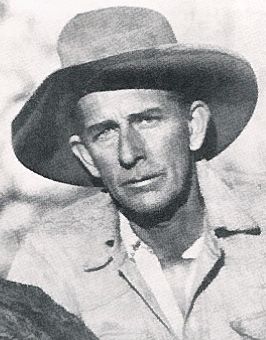
Name: SMITH, Thorold Murray 'Nimrod' MC
Birth Date: 18 Dec 1886 Sandown, Isle of Wight
Death Date: 27 Apr 1972 Stotfold, Bedfordshire
First Date: 1920
Profession: Well known professional big-game hunter. Foundation Member EA Professional Hunters' Ass. President 1959/60. Retired to Lewes in Sussex
Married: 1. Barbara 'Babs' d. of leukaemia; 2. Ida Violet Clifton b. 14 Sep 1906 Southampton, d. 1 Aug 1939 Southampton; 3. In Cardigan 12 Feb 1945 Mrs Annie Gwendoline Wetherall née Lethbridge b. 1894, d. 13 Dec 1978 (dau. of John Acland Musgrave Lethbridge)
Author: Alan Wykes, 'Nimrod Smith', 1961
Book Reference: Ker, Ruark, Nature, Nimrod, Sundown, Who's Who, Chandler
War Service: Served in France in WW1 - wounded. Awarded MC in 1915. WW2 with Intelligence in Abyssinia
School: Marlborough
General Information:
He was a decorated WWI veteran (White Hunters, by Brian Herne, p. 172). At the outbreak of war. he joined up immediately and was commissioned into the Hampshire Regiment and was on the front within two weeks; he was gassed at Ypres. but otherwise was uninjured. He won his MC in April 1915 for doing an intelligence gathering raid on German trenches, whilst attached to the 2“ Border Regt. (Nimrod Smith, by Alan Wykes, pp. 34-5).
In the summer or 1919 he was working in Bristol Zoo, and was nearly killed by an elephant, but for the prompt action of a boy who was later to become his biographer, Alan Wykes (Nimrod Smith by Alan Wykes, pp. 18-19).
He arrived in East Africa in early 1920, and met up with Philip Percival who was on safari with the Duke of Orleans with which he helped out (ibid. pp 46-7). Sometime between 1921 and 1938 he worked for Safariland (lWhite Hunters, by Brian Herne, p. 175). He did a long safari for Newland & Tarlton in 1921 for two Americans coming down the Nile from Juba. He also hunted with the Duke of Aosta on the same trip. (Nimrod Smith by Alan Wykes, pp. 45-62. 62). He also took the Maharajahs of Jodhpur and Bikanir out on safari, albeit separately. (ibid, p.141)
In 1925. he sold some tusks in London for what he believed was the highest price then (30/- per lb.) —it was for a pair of particularly thick tusks that a sculptor called Walker wanted for a particular sculpture which he made, a carving of the Virgin & Child (ibid. p. 174)
President of the EAPHA in 1958 and 1959 (Men for All Seasons, by A. Dyer p. 347). Included amongst the East African hunters (1903-1977) (Tony 'Maxtone-Mailer’s List March 1990).
Early on in WW11 he was in the NFD doing much gathering of intelligence with respect to the lie of the land (Nimrod Smith, by Alan Wykes, p. 193). After the fall of Addis Ababa in April 1941, he coincidentally met up with Philip Percival, Syd Downey, Vivian Ward, and Pip Beverley at the offcers’ mess. With Philip Percival presiding they held a meeting of the EAPHA. They held a second meeting at the White Eagle Hotel about a month later, which ended up with a boisterous party enlivened by much captured enemy booze (White Hunters by Brian Herne, p. 175).
His gunbearer, friend and companion was a man called ‘Manda Koka’ who was with him for 35 years and his hunting partner was ‘Mwalimu Manza’ (White Hunters, by Brian Herne, p. 176).
In 1945 he was called to M'pulungu at the southern end of Lake Tanganyika to hunt meat for several hundred Polish refugees (Nimrod Smith, p. 98). He had a client in 1948 called Dean Witter from San Francisco, who wrote and published his experiences (ibid. p. 261).
He became friendly with Grace Kelly during the filming of ‘Mogambo'. He shot a giant python and gave her the skin which she later made into a suitcase. Even when she became Princess Grace of Monaco, she still remembered him and always sent a note with her Christmas card. He also gave Clark Gable his lion-skin cap and in return was given a pearl-handled .38 revolver, which Gable had smuggled in (White Hunters, by Brian Herne, pp. 192 & 195).
Bill Jenvey said that “...he was always adamant that clients developed a sportsmanlike conception of wildlife and hunting” (ibid. p. 179). He hated cars when they arrived in BEA, and once was found beating the front of his car with a kiboko shouting ‘If you were a bloody ox wagon I would know what to do with you." (A Man for All Seasons, by A. Dyer, p. 317). He suffered from an acute coronary thrombosis in 1957, which pushed him to retire to Greatworth, near Banbury in England (Nlmrod Smlth, by Alan Wykes, p. 22).
His first wife was Barbara, the daughter of a Southampton businessman. ‘Babs’ contracted a wasting illness, and eventually died (ibid p.71). His second wife was Gwendoline Lethbridge, daughter of the colourful Nairobi settler, Jack Lethbridge. She was born in Canada and lived with her father from 1906 (ibid p. 22). He was son-in-law to Capt. Jackie Lethbridge. Jackie was a tough old war veteran who fought the Boers before arriving in BEA in 1902. Although he was never a hunter, he liked to hunt lions (White Hunters, by Brian Herne, pp. 23-4).
He died in 1964 (Ker & Downey by Jan Hemming, p. 38). He wrote The Nature of the Beast and Safari Trail.