
View entry
Name: ANDERSON, Charles Groves Wright VC, MC (Lieut.-Col.)
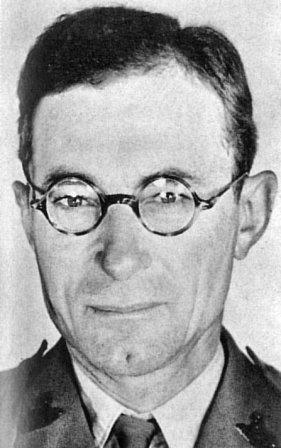
Nee: brother of Claude, Gerald and Maia, son of Alfred Gerald Wright Anderson
Birth Date: 12 Feb 1897 Newlands, Cape Town
Death Date: 11 Nov 1988 Canberra, Australia
First Date: 1922
Last Date: 1934
Profession: Farmer
Area: Mount Margaret Estate, Escarpment
Married: In Nairobi 21 Jan 1931 Edith Marian Tout b. 28.8.1907 Young, NSW, Australia, d. 10 Mar 1984 Woden, ACT, Australia
Children: Elizabeth Gay (16 Sep 1932 Nairobi); Nicolas Gerald (twin, 12 Nov 1934 Nairobi-1988); Jeremy Charles (twin, 12 Nov 1934 Nairobi); another
Book Reference: KAD, Red 25, Red 31, Land, Red 22, Red Book 1912, LG, Gazette, Red 19, Monuments, Web
War Service: 3 KAR in WW1, MC; WW2 Malaya, VC
School: Nairobi European School
General Information:
On his return to Africa, Anderson enlisted in the local volunteers in November 1914, following the start of World War I. Next year he joined the Calcutta Volunteer Battery. On 13 October 1916 he was commissioned temporary lieutenant in the King’s African Rifles. Serving with the 2nd Battalion, 3rd Regiment, he displayed outstanding leadership during fighting at Nhamacurra, Portuguese East Africa (Mozambique), in July 1918 and was awarded the Military Cross (1919). Before he was demobilised in February 1919, he was promoted to temporary captain.
Turning to farming, Anderson served as chairman of the Kenya Settlers’ Association in the Rift Valley district. At the Anglican Cathedral of the Highlands, Nairobi, on 21 February 1931 he married Edith Marian Tout, a niece of (Sir) Frederick Tout, who came from Young, New South Wales, to tour Africa. During a subsequent visit to Australia, Anderson was impressed by his wife’s home country. In 1935 they migrated to Australia with their daughter and twin sons. He purchased a 2200-acre (890 ha) grazing property, Fernhill, at Crowther, near Young.
On 3 March 1939 Anderson was appointed a captain in the 56th Battalion (Riverina Regiment), Militia. Promoted to major in October, he transferred to the Australian Imperial Force on 1 July 1940 as second-in-command of the 2/19th Battalion. Seven months later the battalion embarked for Singapore. On 1 August 1941 Anderson was promoted to command the battalion as a lieutenant colonel. Of medium height and slender build, softly spoken and bespectacled, he did not look the forceful and incisive commander he was about to prove himself. One of the few officers with experience of jungle fighting, he trained his men in bayonet use and snap shooting.
Following the Japanese invasion of Malaya in December, the 2/19th was sent to the Muar area on 17 January 1942. The unit arrived at Bakri next morning and by that evening was under fire from the guns of the Japanese Guards Division which, supported by tanks, was decimating the inexperienced 45th Indian Brigade and causing heavy casualties to the 2/29th Battalion already sent to reinforce it. When the brigade headquarters was bombed on the 19th, Anderson took command. After waiting to gather survivors into his perimeter, he decided on a fighting withdrawal to Parit Sulong. Joining his forward company the next morning, he destroyed two machine-gun posts with grenades and shot two enemy soldiers with his revolver, then personally led the assault that broke through the encircling Japanese.
Despite sustained air and ground attacks which caused further heavy casualties, the withdrawing troops covered 11 miles (18 km) carrying their numerous wounded. Nearing Parit Sulong, they learned that the Japanese had already arrived in strength and seized the bridge there, cutting off the retreat. Anderson resolved to fight on and mounted further attacks on 21 January, but his weakened force was unable to achieve a breakthrough. At 9 a.m. next day, realising that relief was equally impossible, he ordered all personnel still capable of walking to destroy heavy equipment, including vehicles and guns, then slip away around the blocking enemy posts.
About five hundred Australians and four hundred Indian troops—a fifth of the force originally involved—reached British positions at Yong Peng on 23 January. Anderson was sent back to Johore Bahru to reconstitute his shattered unit from recently arrived reinforcements, but was hospitalised with dysentery on 8 February. He did not rejoin the 2/19th until 13 February, the day before it was announced that he had been awarded the Victoria Cross—the only Australian commander in World War II to be so honoured. On the 15th, despite his heroic efforts at Muar River (later considered a minor epic in an otherwise disastrous campaign), Anderson joined the rest of the Singapore garrison in captivity following the British surrender.
Appointed second-in-command of `A’ Force, the first group of 3000 Australians employed on the Burma-Thailand Railway, Anderson left Singapore in May. He took charge of a group of Allied prisoners working on the northern section of the railway. In negotiating to reduce the privations of his men, he frequently risked (and on at least one occasion received) a beating from Japanese guards. His personal conduct became legendary and helped to sustain prisoners’ morale. Freed after Japan’s surrender, Anderson was repatriated in November 1945 and next month placed on the Reserve of Officers. He returned to farming near Young and later took over a property, Springfield, that his wife had inherited.
At the 1949 Federal election Anderson won the House of Representatives seat of Hume for the Country Party. He became an advocate for rural issues and for improving the rehabilitation of service personnel. Defeated in 1951, he stood unsuccessfully in 1954 before regaining Hume next year; re-elected in 1958, he served until again defeated in 1961. During his second term, he was a member of the joint committees on the Australian Capital Territory (1957-61) and foreign affairs (1961).
In 1955 Anderson had revisited Kenya and Britain; in 1959 he returned to Thailand as special Australian representative during wreath-layings on war graves at the River Kwai. He retained his military links, becoming honorary colonel of the 56th Battalion (1956-57) and the 4th Battalion (1957-60), Citizen Military Forces. In 1968 he again visited Malaya as the guest of the British 17th Division, which was conducting a study tour of the Muar battle. On 11 November 1988 he died in his home at Red Hill, Canberra, and was cremated with full military honours. He was survived by two daughters and a son; his wife and their other son predeceased him. A pencil drawing (1942) by Murray Griffin and a portrait (1956) by J. B. Godson are held by the Australian War Memorial, Canberra. Another portrait, by (Sir) William Dargie, entered for the Archibald prize in 1948, is in the family’s possession.